Reprinted from The Times Magazine, 19 February 2011
By Janice Turner
It is Saturday night in Paris, yet no one in the House of Dior is thinking of dinner. In the lily-scented offices on the Avenue Montaigne, Sidney Toledano, genial and leather-jacketed, pulls staff into impromptu meetings in doorways. Soigne PRs stop their frantic BlackBerrying only to riffle through boxes of chocolates (fashion folks feed only on sugar, like hummingbirds). Above them on the fifth floor of this mansion building where Christian Dior began 66 years ago, seamstresses and tailors – the atelier’s “petits mains” – work under blinding white lights, pinning lengths of silk and gauze, panels of feathers and beading.
It is just 36 hours until Dior will present is haute couture show to the world’s fashion press and a clientele of women rich enough to pay £50000 for a single garment. And yet nothing is finished. Not one dress. Some embroidery hasn’t even arrived yet from specialist workshops across France. A lone corset with a hand-span waist, exquisite in itself, stands awaiting its gown. But this tardiness is almost a tradition: the all-nighter pulled by the entire atelier the night before a show, “la nuit blanche” – the sleepless white night – is a noble endurance test. My Dior minder bids farewell to the toiling tailors with a rallying cry of, “Bon courage!”
The man on whom they all depend, the wellspring of Dior’s £588 million annual profits, who creates not only couture but a fashion collection of some kind every four weeks, is sitting alone in his large, empty studio.
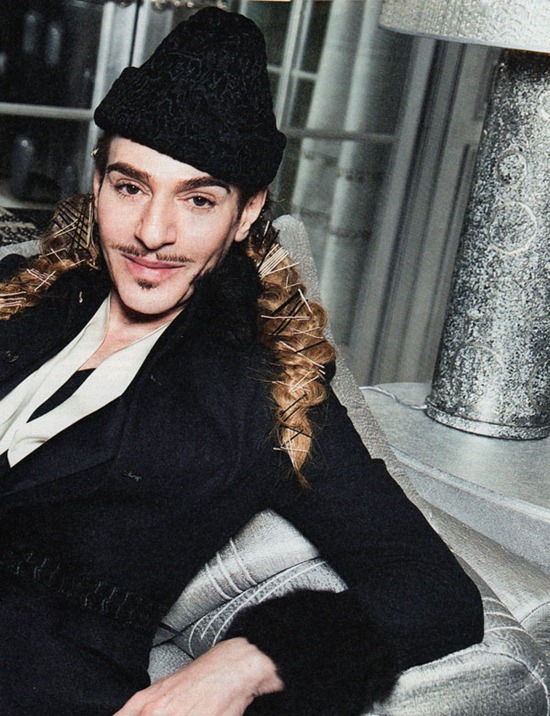
John Galliano is small and slight and bizarrely dressed. Black astrakhan hat, green doublet, shorts, woollen leggings and socks folded over scuffed work boots. His hair falls in two long straggly plaits. To my untrained fashion eye he could be Rumpelstiltskin or one of Santa’s more malevolent elves.
Most designers evolve a uniform that transcends fashion – Lagerfeld’s high-collar shirts, Ralph Lauren’s cowboy denim – but Galliano’s appearance is as quicksilver as his trade. Buccaneer, gigolo, Italian nobleman, pearly king… he;s been all of them. Who are you today, I ask. Perhaps it’s impertinent, because he replies, “John Galliano, I hope,” then adds, “I am always astounded that people ever ask me, “Why do you look like that?” Because it is a culmination of the creative process. When you are living it, breathing it, this muse, whether it’s men’s or women’s fashion, you become it. It’s a bit like an actor, a method, Lee Strasberg, if you like. The you shed that skin and you are on to the next adventure.”
Later, when I ask him if he ever wishes he was born a woman so he could wear his elaborate couture creations, he says, “I don’t need to wish. I was a woman many times. I’ve had 1,891 previous lives.” I snigger, thinking he’s joking. But Galliano glares. “Yes, on my first trip to China I met Shaolin monks. Beautiful people, so calm and disciplined and focused. And they told me I’m a highly evolved spiritual person. I have ten chakras and these 1,891 lives, and they all manifest themselves in my body, as you can imagine.”
So today, the night after he presented his menswear collection, a tribute to Nureyev, he is still manifesting a Russian émigré.
In fact, Galliano is a British émigré to Paris and before that, aged 6, he was a Gibraltarian-Spanish émigré to South London. Unlike Monsieur Dior himself, born of wealthy industrial parents and who considered becoming a diplomat, the current interpreter of his spirit is a plumber’s son raised in Streatham. And his accent cannons theatrically up and down the social scale, loud and soft, harsh and honeyed, reminding me of Kenneth Williams. One minute he is a duchess, imperiously holding the silence after my question a beat too long, so that I fear he’s about to say something withering. (Which he doesn’t, but, boy, I bet he can.") Then he’s all Brian Sewell, over-accentuating artist’s names, before he swooshes down into camp cockney.
I’d been told firmly before the interview that Galliano would talk me through his couture inspiration, and that my questions – if I were allowed to ask any at all – must pertain to his collection. In Paris, the head of Dior is an emperor, before whom we are all grateful subjects. But, in fact, Galliano is chatty and playful. The aspect of him that is most British, he says, is his sense of humour.
I remark that I’d heard he is the fittest man in Paris, known for having two personal trainers, taking long runs and obsessive daily workouts. "Yes, I probably am,” he says. “Up here (he taps his head) and in the body.”
When he left London 16 years ago to head Givenchy – he moved to the even more prestigious Dior in 1996 – he abruptly stopped being the clubbing-till-dawn London party boy. It was a controversial appointment – this anarchic Englishman, the first British designer to head a Parisian haute couture house since Charles Frederick Worth in the 19th century. France writhed in shame, as it loves to do, at this calamitous decline in its culture.
This was a huge job, employing many thousands of staff, and Galliano knew it. He started to ready himself like a boxer, giving up coffee, alcohol and eating junk; his sole remaining vice is cigarettes. He lights one, tilts back his head elegantly to exhale: “I’ve tried hypnotism in London. Gisele (Bundchen) sent me to a place where they put pins in my ears, which lasted about five hours. I had a woman from New York who came in and said, “Give me every cigarette, every carton in your room"!” And I got in the car and I was so grouchy for give hours that my team said, “Oh John, pul-lease have a faaaag. You are unbearable.”
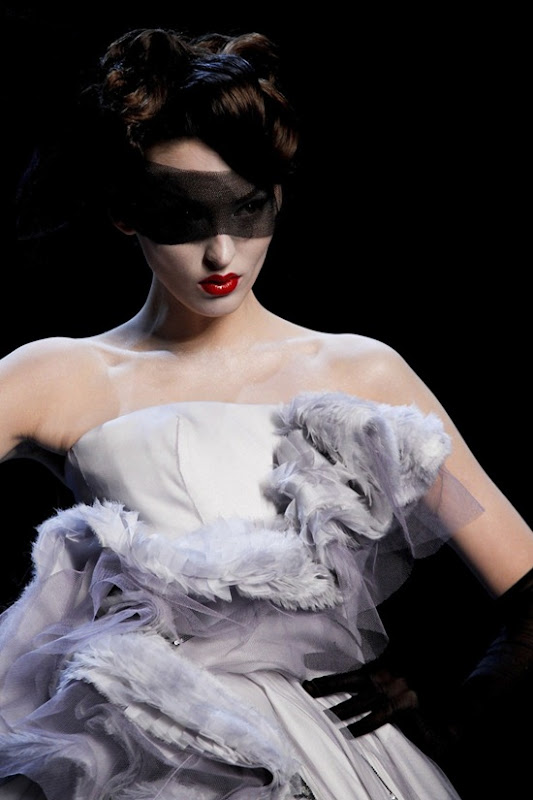
It takes Dior’s PR to pull him back on track, to remind him we must talk about the source of his collection – the work of Rene Gruau, whose vivacious drawings were integral to the House of Dior at the time of its birth. Galliano opens a book on Gruau, for which he wrote the preface, and runs a clear-varnished fingernail down the lovely, effortless lines of a woman in a gown made of feathers, a jaunty hat that is a single brush stroke. Then he tells me how he’s attempted to recreate the light and shadow of the drawings with many layers of fabric, coloured from red to black. “So, hopefully, she will look like an illustration that has come to life.” He shows me blurry Polaroids of the toiles, the linen prototypes. Not being a fashion person, I nod, but don’t see it. To me, the “inspiration” of designers seems often a marketing gimmick.
But Galliano goes on: “There was an exhibition of Gruau in London (at Somerset House). I sent all the kids from here. They were like, “Oh my God, John, they’re like 3-D. Oh my God, John, when I saw the black it also had blue and a Modigliani brown.” It’s taking their noses out of these f***ing fashion magazines and getting to the roots of it. Finding the key to inspiration. it’s the library and its treasures – that’s where you find it.”
Like his body, Galliano’s muse must be properly fed. He is famous for his research trips, travelling to Africa to hang out with Masai tribesmen, with the Shaolin monnks in China, through Indian slums. “There si beauty everywhere,” he says. “But you have to open your eyes.”
Running every morning along the Seine, he grew fascinated by the homeless who live along its banks. “They’re called clochards; I don’t want to say the word “tramps”. They are people who have chosen to live that way. And, out of necessity, they have dressed to battle the elements. They are the most creative people. I take my hat off to them every morning. They know me.”
But when Galliano produced a collection in which he took the layered clochard outfits and remade them in fine fabrics, he caused an outrage. “Dahling, it was like the New Look,” he says, recalling the scandal when Christian Dior launches his extravagant full-skirted style in 1947. “It was awful. I was in the car and I got a phone call from our president, saying, “Don’t get out of the car, there are police everywhere on horses.” It was complete folly. A misinterpretation. The clochards understood.
Being brought up with Charlie Chaplin films, I was more into the romance of it, the charm and poetry. but they twisted it round. And the so-called homeless people who protested had the coolest trainers, Rolex watches, little hoodies. Yeah, riiiight,” he chuckles, and draws on his fag. “Grrrrrreat publicity, though.”
Was it patronising and decadent that a designer recreated homeless apparel in ripped brocade? Or admirable that Galliano sees – and reveres – life beyond the chic streets of the 7th arrondissement? Given his own background, it is fair to assume his motives are genuine. For all his mercurial theatricality, his nutty reincarnations, at root he is grounded, solid, an adored son. I ask if he is a diva and he says, “I am the most normal person you’ll meet in the fashion industry.” He recalls standing with his young design team with the Masai, “And they were going, “This is unreal,” and I said, “No, this is real. Where we come from is unreal.”
John Galliano and his two sisters were born in Gibraltar but brought to England by their parents to be educated. When I remark that he grew up close to my London home, he says: “Oh, the 37 bus, then I’d change and get the No 12 to Trafalgar Square. You never forget your routes.” He went to Wilson’s School for boys in Surrey, no crushy establishment. Was he bullied? “Children can be very cruel,” he says. “I didn’t think I was an oddity. It wasn’t until I went to St Martins College of Art that I realised they were all very odd – the people at my school, I mean. But I escaped, I fantasised. I was never into fashion, not dressing dolls or anything like that. I had a red Chopper bike, which was my horse.”
His Spanish mother who taught him flamenco, dressed her children beautifully. “Even to go to the corner shop she would dress us, polish us, scrub us. It’s very Latin.” She has been to his shows, but at 84 is too old to cope with the circus-like crowd. Has he made her clothes? “Yes, furs. She loves fur.” The family were devout Roman Catholics, and John loved the religious vestments. “There was Holy Communion – outfit! Confirmation – outfit! I was an altar boy – outfit! I did nice o’clock mass – outfit! All this game me a sense of occasion and ceremony.”
He passed his A levels and, always talented at art, won a place at St Martins. He looked set to be an illustrator. “They said I drew like a god,” he declares, and Stephen Jones, the London milliner who has worked with Galliano for 30 years, says the latter will sometimes give him a sketch for a hat, an exquisite depiction in four effortless lines.
To pay his way, Galliano took a job as a dresser at the National Theatre, which he says, gave him a love of costume and drama. “His shows are famous for their theatrical excess, stages in Versailles or the Gare d’Austerlitz, with acrobats or nuns in bondages or the whole arena turned into an Eastern souk.) He became obsessed with Les Incroyables, the dandies of the French Revolution. “Drawing by candlelight, tea-staining paper and putting wet bits of bread on it to take the stain out. Flicking toothbrushes filled with sepia ink and drawing with my left hand, just because it gave a better line.” Only in his final year, when he started studying design, did his tutors suggest he turn his drawings into dresses. And after years spent handing out in Dave’s, the college bar, he disappeared, inspired, into the library.
Such was the calibre of his 1984 graduate show that seats were fought over, and his entire collection was bought by Browns, the exclusive South Molton Street boutique; a coat put in a window was purchased by Diana Ross. “I was 22, a child, and the next day I was in business.” Except he was an artist, with not a clue about finance. While his designs under his own John Galliano label, in particular his bias-cut slip dresses, the default garment of the mid-Eighties, were a sensation, backers came and went.
At times he was living off the largesse of friends, begging dinners, sleeping on floors. Meanwhile, he became a mainstay of the London club scene, in the heyday of Boy George and Leigh Bowery at Taboo, spending days creating an extraordinary outfit for a night of peacocking and debauchery.
Finally, realising his career had stalled, he headed for Paris, ate beans heated on a Primus stove in his decrepit little atelier, until his plight came to the attention of Anna Wintour. With fair godmother-like mafic, she found him a French socialite’s mansion in which to hold his show. The floor was covered in dry leaves, old love letters and a broken chandelier, and the 17 outfits made, through lack of time, from a single bolt of cloth, were modelled for free by Kate Moss, Naomi Campbell and Christy Turlington. New backers were found, order books filled; Galliano was reborn.
How does he feel now, looking back on those precarious early days? “Well, we say “hard times” and, at the time, it felt hard, but now I feel like they were blessings,” he says. “The wisdom, the knowledge… Yes, I had big knocks. But it is a ton of gold – the mistakes you make, the things you learn.” A lack of inherited privilege, this hard-won success, gave him a drive, a hunger: “You never forget how hard your parents struggled, how hard my father worked. How much they suffered and sacrificed. And I am still hungry, because I know what it is to be out there.”
Stephen Jones recalled when Galliano arrived at Givenchy. “Throughout all these hand-to-mouth years in London, we had always dreamt about these Paris salons with marble floors and chandeliers, and suddenly we were there,” he says. “But, really, I was not surprised. His tutors knew he was special from day one. Nothing John does is in the third person. He doesn’t have a yacht or a villa in Capri; he just loves fashion. he’d spend his last pound on a yard of organza.”
It must be exhausting, the ever turning fashion wheel, pushing out so many collections – besides his myriad collections for Dior, the designer has his funkier, younger John Galliano label, a children’s collection with Diesel and other joint ventures in opticals, jewellery, shoes… “I’m full of energy. I’m constantly inspired. I’m not afraid of the blank page,” he says. “But you’d faint if you saw my agenda – I’m booked up until 2013.” Does that never feel oppressive? “Occasionally you’re like “F*** that, I’m missing out on the moment.” So sometimes I just walk away from it.”
He is silent about his private life, although it is known that he lives with his boyfriend near the Marais district of Paris. But he is no raucous partygoer any more, conserving his energy for work. he was 50 last year, though he doesn’t look it – his skin is taut and creamy, which he puts down to a biochemist who makes him special creams.
Does he feel nervous before the show? “There is a burst of butterflies when the ambient music goes down and you can hear the crowd get louder and louder.” And afterwards? “I float,” he says.
Two days later, on a drizzly Monday at the Musee Rodin, models are being made up in a long tent. It says much about Galliano that so many of his inner-circle collaborators are old London mates: DJ Jeremy Healy on music, Stephen Jones on hats; Michael Howells, who dresses permanently like the biker from the Village People, designs his sets; and Pat McGrath, a stately black woman who commands a vast team of make-up artists, who are paining models’ legs white and affixing red paper eyebrows. Galliano’s current muse, Karlie Kloss, is there, more than 6ft tall, an etiolated alien. Photographers and documentary-makers blunder between girls like heavy bees.
Gradually, swarms of high heels arrive, struggling not to snap ankles on the museum’s wet cobbles. Couture attracts a peculiar crowd: multi-facelifted Americans and French, a few celebs (film director Pedro Almodovar, model Stella Tennant and photographer Patrick Demarchelier), besides the key sign of global power transfer, a group of Chinese ladies in furs.
There are those, and I am one, who could never see the point of couture; an unaffordable, unwearable irrelevance. but, as the show begins and John Galliano sends his models down the catwalk in their 12cm heels – the highest a human being can physically walk in – with the sulky mien of affronted debutantes, I start to understand.
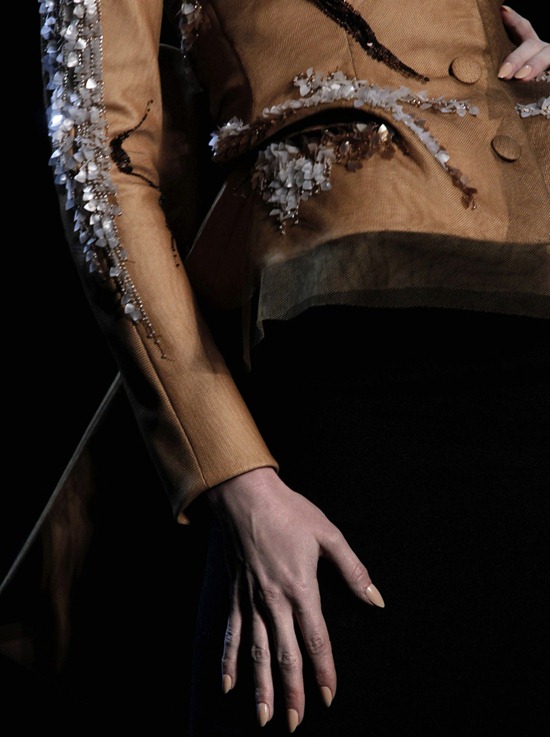
I am reminded of the petits mains, comfortable middle-aged ladies – the only normal-looking people in fashion! – working for Dior for 30 years, with their little spectacle cases of pins around their necks, sewing all through la nuit blanche. I feel suddenly moved by the skill and untold hours invested in this 12-minute show. And I finally see what Galliano was trying to tell me; the layering of cloth, which has the effect of shadow, a panel of beading like a crayon stoke, the quizzical line of a hat, which does indeed resemble the artful sweep of a brush. Galliano has made the effervescent drawings of Rene Gruau walk in the world.
Maybe it is a distraction to think of couture as clothes, since the catwalk versions are mostly too extreme even for a wedding day or the Oscars. It doesn’t seem the time to worry about this cruel, severe silhouette, designed by a gay man for freakishly slender girls. And the question “What is the point of couture?” seems as asinine as, “What is the point of Picasso or the Eiffel Tower?” It is art, yet, in a sense, more exciting and urgent, more severely scrutinised, more prolific, fuelled as it is by a voracious industrial machine.
As the last model leaves, there is a theatrical pause and the lights come up again. Galliano himself struts onto the catwalk and throws a pose. He looks nothing like the man I met on Saturday night, dressed now in a black flared catsuit with braiding and red neckerchief, his hair black and feathered like Peter Sellers in a Sixties sex comedy, or Jason King. Later, after I fight my way through a surging, crazed yet gorgeously perfumed mob outside his private tent, I find John Galliano taking compliments from courtiers. He is quiet, gracious, but looks utterly spent. Who are you today, I ask this kaleidoscope of a man. “I am Rene Gruau,” he says, tickling off another of his 1,891 lives.
Photo source: The Times magazine, February 2011