Showing posts with label John Galliano. Show all posts

Friday, 26 October 2012

That very special Vogue 1999 editorial

vogue-us-october-1999-2

I trust you enjoyed yesterday’s treat video. I certainly did. Being true to myself I then went through my files to find the couture editorial mentioned in the story. I had to – it was too beautiful not to publish. That photo of Kate in dreamy white Chanel Haute Couture gown that made her look like an Angel has always been a favourite of mine, while the black and white portrait featuring beautiful head piece / earrings created by Galliano for Dior Couture make me think of a very similar piece designed by Riccardo Tisci for Givenchy Spring/Summer 2012 Haute Couture collection (and then used in Dalhia Noir campaign). But enough talking – enjoy the photos.

vogue-us-october-1999-1

vogue-us-october-1999-3

vogue-us-october-1999-4

vogue-us-october-1999-kate

Photo source: Vogue US October 1999

Thursday, 25 October 2012

Better than The September Issue

© Noa Griffel 2012

Last  night I found a documentary I was absolutely unaware of. Seconds later the tiredness was forgotten and my bed time postponed. I had to watch it immediately.

If you saw The September Issue, you will enjoy this story directed by Christine Hall for BBC1 as a part of Boss Women series. The camera follows Anna Wintour as she works on the February issue of Vogue, travels to Paris and shares her memories and thoughts about fashion and life.

To me, this documentary felt more frank, more sincere – there was definitely less hype and more depth in it compared to the latest one. It made me like Anna even more. I found her, yet again, absolutely fascinating.


Photo source: Noa Griffel

Wednesday, 5 September 2012

Stylish quote

vogue_china_july2010_2

“It’s taking noses out of these f***ing fashion magazines and getting to the roots of it. Finding the key to inspiration. It’s the library and its treasures – that’s where you find it.”

John Galliano

Photo source: Vogue China July 2010

Sunday, 2 September 2012

The secret torments of Galliano

galliano-dior-couture-spring-2008

re-printed from The Sunday Times Magazine, 21 August 2011

John Galliano’s anti-semitic outburst in Paris cafe cost him the top job in fashion. He had already lost his closest friend and colleague, Steven Robinson. The sordid reality of Steven’s death and its impact on the designer has gone unreported – until now. David James Smith investigates.

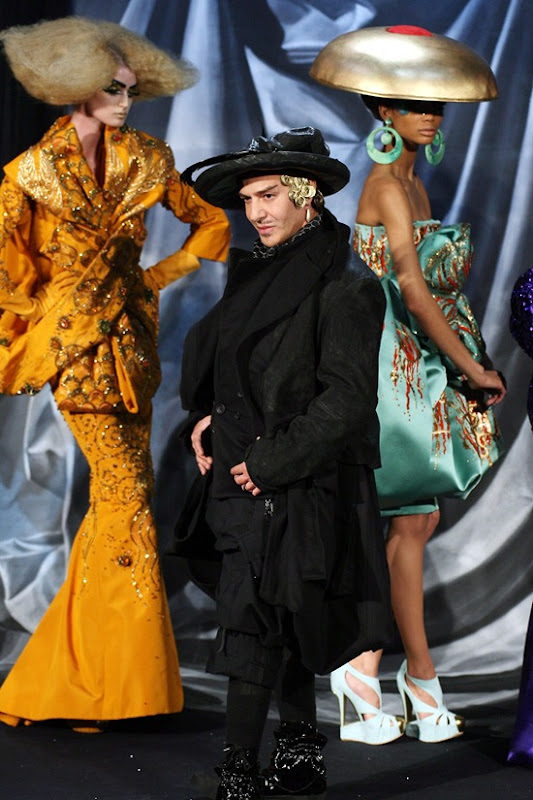
John Galliano had become famous over the years for his bold appearances on the runway at the close of his fashion shows. He might be dressed as an astronaut, a butterfly collector or a matador. The disguises seemed like the showman stunts of an extrovert, a man brimming with chutzpah and self-confidence, but of course things are rarely quite as they appear, especially in fashion.

The truth is, those disguises enabled Galliano to hide himself and the strain and uneasiness that were his regular companions. As he got older and more anxious about ageing he would use a special model’s trick, a Mark Traynor Isomertic Beauty Band – a kind of invisible headband that pulled back the skin on his face and smoothed out some of his wrinkles. Significantly, he turned 50 last November, marking the occasion with a party at the Savoy in London, where close friends and colleagues were entertained by a cabaret of impersonators. He seemed a shadow of himself that night, I was told.

I thought of all that as I sat in the public gallery in June and watched him, in his baggy pantaloons, standing trial on charges of racism and anti-semitism. Stripped of any disguise, facing the possibility of jail for the alleged stream of abuse he had directed at a couple in a Parisian cafe in February – just a few months after his birthday – he seemed contrite, his body shaking as he stood at the bar and answered the judge’s questions.

In the 17th chamber of the Correctional Court of the Palais de Justice in Paris, Galliano gave testimony to the pressures he faced in his work, and how they had led him to succumb to the triple addictions of alcohol, Valium and barbiturates which, he implied, had caused his offensive outburst.

He also spoke movingly of the impact upon him of the death of his closest friend and colleague, Steven Robinson, who had died in 2007 aged just 38, apparently of natural causes. Press coverage at the time suggested he had suffered a fatal heart attack. They had been together for 20 years and he told the court how, after Robinson’s death, he started drinking seriously.

Robinson had joined Galliano as a teenage intern, back in London in the late 1980s. He started out sewing buttons for the struggling designer, but over the years had become central to Galliano’s success, the key figure in the background, leaving Galliano to take centre stage at the House of Dior. “He protected me from everything,” Galliano told the court, “so I could just concentrate on being creative.”

From humble beginnings in Norfolk, Robinson had established himself, quietly, at the apex of the fashion world. A familiar behind-the-scenes figure in his trademark polo shirts, he seemed shy and reserved to many – a big, cuddly teddy bear, was how one woman described him to me – but he had a wild side too.

Galliano was deeply affected by his death but he had not taken the time to grieve, he said. he had simply gone back to his fittings. Another show was never far off. What Galliano did not disclose during the trial were the true, sordid circumstances of Steven Robinson’s death. The details remained hidden for years, sparing the reputation of Dior, France’s greatest fashion house, its then renowned head designer John Galliano and his “chief lieutenant” Steven Robinson.

At the time of Robinson’s death, Dior was about to celebrate its 60th anniversary at the Palace of Versailles – an event Robinson had helped to organise, and at which his memory was honoured. We have discovered that a year later a drug dealer was convicted of “involuntary homicide” for his role in Robinson’s death, and that John Galliano himself gave evidence in open court. Incredibly, there was no news coverage of this trial at all, as there would have been if it had happened in Britain. Somehow, the dramatic proceedings were missed by the entire media circus that surrounds the Paris fashion industry.

Robinson’s body was found by a housekeeper arriving to clean his first-floor apartment above a falafel shop in the Marais district of Paris, which might loosely be called a bohemian quarter of the city. It’s also the traditional Jewish quarter – Galliano lived in that area too. La Perle, the cafe where his alleged racist outburst had occurred, was close to Galliano’s home and only a few hundred years from Robinson’s apartment.

I understand that Robinson’s body may have lain undiscovered for 12 hours or more after his death.

Dior staff are said to have attended the scene and, despite clear evidence that drugs must have played a part, the cause of death of only ever described in the press as a heart attack. The full details of Robinson’s demise could remain hidden because there was no public inquest, as there would have been in Britain, and French privacy laws do not allow for open access to records such as death certificates, which, again, would be readily available in this country.

Robinson was far more than just a back-stage figure. As head of studio for both the Dior and Galliano brands, he was the linchpin of Galliano’s world. The two men had struggled together for many years before finally ascending to the top of the great French fashion house. They were not a couple in the romantic sense, but Robinson was always at Galliano’s side and the commanded a business worth millions to Dior’s owners, LVMH (Louis Vuitton Moet Hennessy), the world’s largest luxury products conglomerate whose turnover last year topped 20 billion euros. While the Galliano brand struggled to break even, revenue at Dior rose from 127 million euros in 1994, when Galliano became head designer, to 826 million euros last year. Being Dior’s head designer was arguably the greatest job in fashion – but it came at a price: be careful what you wish for, Galliano had told a friend in recent months.

By the spring of 2007, Galliano and Robinson had been at Dior for 11 years. The pressures were immense and mounting, with the recession biting and Galliano’s own label struggling financially, as he disclosed at his trial. The sheer effort of producing an endless cycle of designs and shows was taking its toll. Galliano spoke in court of crashing after his shows as he tried to cope with the anti-climax that always followed. Fellow designer Alexander McQueen had experienced the same difficulties and had spoken of terrible, depressive lows he would sink into after his shows – a pattern that would contribute to his suicide in February 2010. He too was found by his housekeeper, at his flat in London’s Mayfair. He had hanged himself in his wardrobe.

Fashion shows are short but huge productions, only achieved by sleepless nigh and intense attention to detail. Robinson had told a New Yorker writer as far back as 2003, “this is so much work for 20 minutes you can hardly believe we keep doing it.” In the year he died, someone recalls seeing him high as a kite after one of the last shows, screaming hysterically. He had a reputation for using drugs such as cocaine, long after others, including Galliano himself, had stopped. Insiders will tell you that at Dior, as elsewhere in the fashion industry, illegal drugs were commonplace. I was told that, after the last show before his death, Robinson had told Galliano he did not want, or feel able, to continue their work together. Usually at this break in the cycle of shows they would have gone on holiday together. Robinson was invited but declined, so Galliano and some friends went off and Robinson stayed at home.

The person who first told me how Robinson had died was so “paranoid” about giving the story away that they could not even speak the words. Instead they wrote down in my notebook “500 x lethal dose cocaine”.

For a long time that was all I knew. There was a fear about speaking out, among some people, as well as a desire to protect those involved and also perhaps for some, to protect their own jobs or relationships with friends and colleagues.

Then, many weeks later, I had a breakthrough at the French courts. Just over a year after Robinson’s death, in July 2008, a Senegalese migrant with no legal papers, Alassane Seck, was convicted of involuntary homicide (the French equivalent of manslaughter) in the death of Steven Robinson, and of carrying and dealing drugs. Seck’s lawyer, Francois-Henri Blistene, told us that Robinson had died of a massive cocaine overdose, toxicology showing he had between give and seven grams in his body (around five times the potentially lethal dose), which he had apparently snorted.

Robinson had a history of being a cocaine user, and a drug user in general, and it came out in open court that he had been treated for a history of severe depression. (I was told by someone who knew him that he was a “friend” when it came to cocaine.)

Seck had denied selling Robinson the drugs that killed him, but he was found with the cash that Robinson had withdrawn from a cashpoint to pay for the drugs. He said Robinson was one of around 30 prestigious clients he sold to. According to his lawyer, the dealer was friendly with all his customers and on good terms with Robinson and his social set. he had built up trust with them, even though he was not Robinson’s only drug supplier.

Seck was in his late thirties and had been a drug dealer for 15 years. By day, he sold African souvenirs around locations such as the Eiffel Tower and the Acr de Triomphe. His lawyer, Blistene, would not identify the other “big names in the fashion world” with whom the dealer associated, but said they were mostly from the “old guard” who used to go to Le Palace, a popular nightclub for designers and models in the 1980s and early 1990s. In the end, some 40 people had testified to Seck’s business as a drug dealer, but his lawyer would only name one other client to us: Francois Baudot, a government cultural adviser and godfather to Carla Bruni’s son, Aurelien Enthoven. Baudot committed suicide last year, aged 60.

Galliano testified at Seck’s trial, claiming not to know that Robinson was taking drugs and, according to Seck’s lawyer, speaking movingly about Robinson as a wonderful young man who had been his protégé. Seck was sent to prison for seven years. He appealed in April 2010 when the conviction was upheld, but his prison term was reduced to six years. He had since been released, having served half his sentence. Somehow, these proceedings went unreported, and their connection to Dior and Galliano was completely missed. This is the first time they have been made public.

I was initially told by someone who knew Galliano that Robinson’s family had been kept in the dark about what had happened, but that cannot be true as they were represented at Seck’s appeal – their lawyer was apparently paid for by Galliano personally. How and why Robinson came to take such a huge overdose, whether he intended to take his own life or inadvertently killed himself in pursuit of temporary oblivion, is impossible to know. There are certainly those who believe his death was suicide, brought about by the unrelieved pressure of work. I have wondered how Galliano must have felt. Terrible, I guess. Very guilty, probably. He was on holiday and his friend died alone.

I tell this story not to smear Robinson or pour more hurt on Galliano, but because I think it goes to the heart of a wider concern that, put simply, the fashion industry destroys its greatest talents and fosters a romantic myth about drugs and glamour. Some people around Galliano who still care about him (others alienated by his outburst in the La Perle cafe and feel let down, even angry with him) feared that he took could have gone the same way as Robinson and Alexander McQueen.

Galliano’s solitary presence in the cafe, nursing his addictions, casually getting into an unseemly row with a couple and being racist and anti-semitic towards them was worrying, just as much as it was unpleasant, for anyone who cared for his wellbeing.

Even if Galliano’s troubles predated Robinson’s death, there is no doubt that the loss of his friend exacerbated them, and perhaps, led to his deteriorating relationship with Dior. He and the head of LVMH, Bernard Arnault, were said to have disliked each other and there were endless difficulties with the Dior head, Sidney Toledano. I could not persuade Toledano to talk to me in detail for his article. We had no more than a brief conversation backstage at a show, but I know that Galliano felt undermined by his bosses – particularly when the appeared to be interviewing potential replacements while he was still in his job. “They interviewed everyone,” was the story I heard.

Galliano’s behaviour became increasingly difficult and bizarre as the strain increased. By his own admission, he sometimes started drinking in the morning and took sleeping pills during the day to try and cope with anxiety. in addition to the loss of Robinson, he was said to have been deeply affected by the suicides of  both Isabella Blow, in 2007, and McQueen, in early 2010. He knew that McQueen – eight years his junior – had at one stage been coming up as the young pretender, perhaps, deliberately placed by LVMH in the same role Galliano had once held, as the head designer at another LVMH brand, Givenchy.

Galliano had felt the threat of McQueen’s talent, I was told. But they had become friends, out of their common bonds: they both came from ordinary London backgrounds, had both known they were gay from a very young age, and were bound together, too, by their talents as designers. You wonder if each of them knew that the other was fighting a losing battle with his demons.

Bath Galliano and McQueen had spent time studying fashion at Central Saint Martins, albeit some years apart, at the start of their careers. Bobby Hillson, who had known and admired them both while she was running the MA course there (for which she hired McQueen to teach), knew that it was not easy to help her students to manage the conflict between creative desire and commercial expectation. “Of course, you try and prepare them, but you can never really prepare anybody for the sort of pressures they are going to face. You try and explain that it’s a business, but that’s an especially difficult message for the really creative ones like Lee (McQueen) and John, and that in itself can take everything out of you – let alone preparing for the next collection and looking at what’s sold and what hasn’t.”

Galliano had been in a relationship when he was starting out with another Saint Martins graduate, the designer John Flett. He too had been eager to make his name, independently of Galliano, who was already  becoming well known. Galliano’s 1984 graduation show, Les Incroyables, had been bought up outright by then-leading London fashion retailer, Browns of South Molton Street.

Flett never got the breaks Galliano did. An outgoing, extrovert character, he met the Paris designer Claude Montana in a night club and began working for him, but struggled to build a reputation in his own name, while continuing to be a keep party-goer and, it was said, drug user. By the end of the 1980s he and John had long since separated and he was in Italy working for another designer, waiting for him to deliver on a promise to launch his own-name brand of clothes. He died of a heart attack in a hotel in Florence in January 1991, at just 27 years old. Some say it was a drug-induced death; others suggest he felt the strains and disappointments of his trade.

Meanwhile, Galliano himself was struggling through most of those years after graduation. After the split with Flett he was in a relationship with another rising designer, Jasper Conran. It appears they had different attitudes to their future, Galliano believing that publicity and a famous reputation would be the makings of him, while Conran was focused more on the financial security and success that eluded so many of his contemporaries.

Galliano’s first backer, Johann Brun, financed his shows and tried to persuade him of the need for a commercial aspect to this work. But Galliano was being feted by Vogue and others in the industry, and assumed financial success would soon follow. When it didn’t the two men got into disagreement and eventually their company John Galliano/Brun went into liquidation – the first in a series of Galliano “bankruptcies”.

Brun recalled how hard Galliano worked and how he drew people to him easily, already assembling the team that would stay with him through the years, including Bill Gaytten, Galliano’s pattern cutter who has since stepped out onto the runway as Galliano’s replacement designer. “He was always angling,” said Brun of Gaytten. Other members of the inner circle, in addition to Robinson and Gaytten, included the milliner Stephen Jones, the DJ Jeremy Healy, and the production designer Michael Howells.

Brun also remembered how Galliano was concerned not to let his parents find out anything adverse about him. Galliano told the New Yorker interviewer in 2003, not long after retuning from his father’s funeral in Gibraltar, that there had been many things left unsaid between them, including the truth about his sexuality:”It was all very Latin and complicated between me and my father.”

Ti his irritation, journalists latched on to the fact, from his earliest publicity, that Galliano was a plumber’s son from Streatham, where his parents had lived when they relocated to England in 1960s. His father, John Joseph Galliano, was Gibraltarian and his mother, Ana, is Spanish. Galliano, who has two sisters, was born in Gibraltar in November 1960. Fabulously, Galliano has always claimed in interviews his real name is Juan Carlos Antonio Galliano-Guillen. He even announced that name to the court at his trial. But this turns out not to be quite the case. I ordered his birth certificate from the Gibraltar registry and in fact he was named John Charles Galliano.

Whatever tensions existed in Galliano’s life in the 1980s, they must have taken their toll; he told Johann Brun he had suffered a mini nervous breakdown at that time, according to Brun. They went clubbing together sometimes, said Brung, but he and Galliano were never really close.

Brun said he never took drugs, and never saw Galliano taking them either, but Galliano has said before that he was a keep part of that avant-garde and slightly out-of-control 1980s club scene in such places as Taboo and Ascension, where everyone, including him, had very often taken something. There was sexual abandon too, especially among the increasingly open and liberated gay community.

Susana Vida opened one of the first designer shops in Soho, selling Galliano’s clothes above a peep-show parlour opposite the Wag Club. The store stayed open until 3am and Galliano had to come in and show the assistant, a two-metre tall transsexual, how to dress the customers in his complex outfits. Customers might be greeted by a naked dancer emerging from behind the shower curtain Susana put up to separate the dancers from the stairs to her shop, which she provocatively names Kunst (the German for art, before you complain).

Later, when Galliano was desperately broke and preparing to leave the city he loved, Susana was selling his sample clothes direct from another store in Neal’s Yard, Covent Garden, and paying him straight in cash. She says she gave him money for his flight to Paris – cash profits from the sale of his clothes – and recalled him as a poorly-turned-out ragamuffin who elected to travel to Paris in a motorcycle suit.

Galliano and Robinson were reunited in Paris. Galliano had a brief but unsuccessful stint with the fashion brand Plein Sud before he and Robinson were once again on their uppers, when Anna Wintour and Andre Leon Talley from Vogue scooped them up, found them some backers and fed them burgers from McDonald’s to keep them going.

The turning point appears to have been the 1994 show that featured the world’s most famous fashion models – Kate Moss, Linda Evangelista, Naomi Campbell and Christy Turlington among them – giving their catwalk services for free, parading a series of beautifully cut black dresses, with just two splashes of pink. Galliano’s muse then was the creative consultant Amanda Harlech. They parted ways when he went to Dior and did not make a role for her; she has worked for some years now with Karl Lagerfeld at Chanel. The 1994 show featured Stephen Jones’ hats, dry ice and rusty keys for invitations, but it left the focus on the clothes, and is widely remembered as a transforming fashion moment.

The head of LVMH, Bernard Arnault, soon began negotiating with Galliano for him to replace Hubert de Givenchy, who was retiring as the head of his own fashion house. Galliano was only at Givenchy a year before he went to Dior in 1996. Galliano has likened the shock of his own arrival at Dior, a punk storming the Bastille of haute couture, to the “scandal” that greeted Christian Dior’s original New Look designs of the 1940s. He certainly scandalised with some of his collections, such as the 2000 show inspired by the homeless people he saw on the banks of the River Seine in Paris. He claimed to be honouring the vagrants, but was widely perceived as mocking them. Other wondered if he was having a joke at Dior’s expense – an “avant-garde f*** you” to the home of fine fashion, as one insider described it.

The seasons fragmented and grew in number, and John had his own brand too, though Dior also owned the Galliano name. Just two days after his June trial, I attended a Galliano menswear fashion show at which an anonymous figure in a denim shirt stepped gingerly out from behind the curtain to take a bow: Bill Gaytten, John’s pattern cutter, who had been thrust into the limelight as the new head designer. The show had nothing to do with Galliano himself. Think of it as Galliano the brand, not Galliano the individual, a press officer told me. Dior still owns 92% if the label. But then of course, they had owned all of John, until they sacked him. He had become a hamster on a wheel, simply working to maintain what he told his trial were his two “children”, Dior and Galliano. He described a dizzying annual round of shows for both labels, menswear, womenswear, young people, beachwear, underwear, jewellery, sunglasses, shows…

Before Steven Robinson said, I was told that sometimes when Galliano was very anxious and alone – he was in a long-term relationship with Alexis Roche, but he was not always around – Robinson would go and sleep at the foot of his bed. Perhaps they both derived some comfort and protection from that. it isn’t hard to imagine how the loss of Robison must have hit him.

Galliano was said to have been barely functioning by the time of Robinson’s funeral service, 10 days after his death in April 2007. It was a measure of Robinson’s importance that more than 1000 people, mainly from the fashion industry, paid their tributes at the American Cathedral in Paris. Designers and heads of fashion houses were there; Naomi Campbell came with Andre Leon Talley. Galliano could not speak but Stephen Jones read a Yeats poem, while the set designer Michael Howells read from Winnie the Pooh.

It was about this time that Galliano began to feel insecure about his job. He was said to have been mortified by a letter from Anna Wintour, advising him to change some of his team, and believed that Delphine Arnault, the daughter of the LVMH boss and thought to be one of the richest women in the world, had been brought in to find someone to replace him.

I was told he had never gone for treatment for his alcohol addiction and could sometimes go for days without alcohol, but then he could behave badly. Some friends believed he wanted out of Dior, but didn’t know how to escape. Where was the exit? As it turned out, the exit was in La Perle cafe where he sat alone and unleashed his torrent of racist and anti-semitic abuse.

Dior moved swiftly to dismiss him as head designer at Dior and were, of course, able to dismiss him from his own label too. Galliano, finally, went for treatment, at Cottonwood in Tucson, Arizona. He was expected to stay for three months, but left weeks earlier and appeared to be back in control as he went to Switzerland and holed up with his lawyer to prepare for his trial.

Nobody knows if Galliano will ever go back to the world of fashion, but he is said to be getting plenty of offers. The story of his decline and fall is a sad but salutary lesson, and at least Galliano is still here to tell the tale himself. It is too late for John Flett, Steven Robinson and Alexander McQueen, but if others learn from the fate of these men and act to clean up fashion and support the great but vulnerable talents of the future, then they will not have suffered and died in vain.


Photo source: Christian Dior Haute Couture Spring/Summer 2008

Friday, 31 August 2012

My favourite Galliano collection for Dior

christian-dior-campaign-fall-2010-meisel-4

If I was a tsarina from Imperial Russia (or, as Galliano imagined, a young lady living in an English countryside, which is almost me) I would like to be born, raised and sent away on the last day of my life wearing these clothes. 

It’s been two years since the Christian Dior Fall/Winter 2010/11 show, and I still want to touch the fabric, admire every detail, the fur, the delicate prints, silk flowers and ribbons, and the peachy soft leather. I long to feel the whisper of organza on my skin. I want to wear pearls and hear their flirty soft clinking.

christian-dior-ready-to-wear-fall-2010-3

christian-dior-ready-to-wear-fall-2010-5

christian-dior-ready-to-wear-fall-2010-8

christian-dior-ready-to-wear-fall-2010-16

I want to open my wardrobe, pick one of these gorgeous creations, the dress, the boots, the bag and all, and run outside feeling like an princess (or still that young British lady in a countryside) in a warm cloud of bliss. Totally impractical and so hopelessly romantic.

christian-dior-ready-to-wear-fall-2010-12

christian-dior-ready-to-wear-fall-2010-14

christian-dior-ready-to-wear-fall-2010-18

christian-dior-ready-to-wear-fall-2010-22

The words can’t describe how much I adore this collection. It took my breath away. It’s so me, I want to cry… As if Galliano saw my dreams, read my mind and made friends with my soul. This isn’t just love… this is a pure desire for beauty, sensuality and femininity.


P.S. The week isn’t over just because it’s Friday. Tomorrow I will share a story and on Sunday – a very special article you would not want to miss.

Photo source: Christian Dior Ready-to-Wear campaign Fall/Winter 2010/11, style.com

Thursday, 30 August 2012

John Galliano, the documentary

numero-88-inspiration-for-fall-2007

This is one of my most recent finds that made me change my mind about writing a usual bio generously sprinkled with photographs. I always feel (and mentioned it several times in the past) that seeing a fashion show has an incredible power over our imagination and emotions – much stronger than any beautiful photo from a collection. Combined with a story told by Galliano himself as well as people who admire his talent turns this documentary into a precious gem. Enjoy this beautiful fashion moment…

Photo source: John Galliano’s inspiration board for Fall 2007 show via Numero No. 88 November 2007

Wednesday, 29 August 2012

Stylish quote

elle-russia-december-2010-d

"Style is wearing an evening dress to McDonalds, wearing heels to play football. It is personality, confidence and seduction."

John Galliano

Photo source: Dior Couture in Elle Russia December 2010

Tuesday, 28 August 2012

“Who am I today? John Galliano, I hope”

john-galliano-thetimes

Reprinted from The Times Magazine, 19 February 2011

By Janice Turner

It is Saturday night in Paris, yet no one in the House of Dior is thinking of dinner. In the lily-scented offices on the Avenue Montaigne, Sidney Toledano, genial and leather-jacketed, pulls staff into impromptu meetings in doorways. Soigne PRs stop their frantic BlackBerrying only to riffle through boxes of chocolates (fashion folks feed only on sugar, like hummingbirds). Above them on the fifth floor of this mansion building where Christian Dior began 66 years ago, seamstresses and tailors – the atelier’s “petits mains” – work under blinding white lights, pinning lengths of silk and gauze, panels of feathers and beading.

It is just 36 hours until Dior will present is haute couture show to the world’s fashion press and a clientele of women rich enough to pay £50000 for a single garment. And yet nothing is finished. Not one dress. Some embroidery hasn’t even arrived yet from specialist workshops across France. A lone corset with a hand-span waist, exquisite in itself, stands awaiting its gown. But this tardiness is almost a tradition: the all-nighter pulled by the entire atelier the night before a show, “la nuit blanche” – the sleepless white night – is a noble endurance test. My Dior minder bids farewell to the toiling tailors with a rallying cry of, “Bon courage!”

The man on whom they all depend, the wellspring of Dior’s £588 million annual profits, who creates not only couture but a fashion collection of some kind every four weeks, is sitting alone in his large, empty studio.

John Galliano is small and slight and bizarrely dressed. Black astrakhan hat, green doublet, shorts, woollen leggings and socks folded over scuffed work boots. His hair falls in two long straggly plaits. To my untrained fashion eye he could be Rumpelstiltskin or one of Santa’s more malevolent elves.

Most designers evolve a uniform that transcends fashion – Lagerfeld’s high-collar shirts, Ralph Lauren’s cowboy denim – but Galliano’s appearance is as quicksilver as his trade. Buccaneer, gigolo, Italian nobleman, pearly king… he;s been all of them. Who are you today, I ask. Perhaps it’s impertinent, because he replies, “John Galliano, I hope,” then adds, “I am always astounded that people ever ask me, “Why do you look like that?” Because it is a culmination of the creative process. When you are living it, breathing it, this muse, whether it’s men’s or women’s fashion, you become it. It’s a bit like an actor, a method, Lee Strasberg, if you like. The you shed that skin and you are on to the next adventure.”

Later, when I ask him if he ever wishes he was born a woman so he could wear his elaborate couture creations, he says, “I don’t need to wish. I was a woman many times. I’ve had 1,891 previous lives.” I snigger, thinking he’s joking. But Galliano glares. “Yes, on my first trip to China I met Shaolin monks. Beautiful people, so calm and disciplined and focused. And they told me I’m a highly evolved spiritual person. I have ten chakras and these 1,891 lives, and they all manifest themselves in my body, as you can imagine.”

So today, the night after he presented his menswear collection, a tribute to Nureyev, he is still manifesting a Russian émigré.

In fact, Galliano is a British émigré to Paris and before that, aged 6, he was a Gibraltarian-Spanish émigré to South London. Unlike Monsieur Dior himself, born of wealthy industrial parents and who considered becoming a diplomat, the current interpreter of his spirit is a plumber’s son raised in Streatham. And his accent cannons theatrically up and down the social scale, loud and soft, harsh and honeyed, reminding me of Kenneth Williams. One minute he is a duchess, imperiously holding the silence after my question a beat too long, so that I fear he’s about to say something withering. (Which he doesn’t, but, boy, I bet he can.") Then he’s all Brian Sewell, over-accentuating artist’s names, before he swooshes down into camp cockney.

I’d been told firmly before the interview that Galliano would talk me through his couture inspiration, and that my questions – if I were allowed to ask any at all – must pertain to his collection. In Paris, the head of Dior is an emperor, before whom we are all grateful subjects. But, in fact, Galliano is chatty and playful. The aspect of him that is most British, he says, is his sense of humour.

I remark that I’d heard he is the fittest man in Paris, known for having two personal trainers, taking long runs and obsessive daily workouts. "Yes, I probably am,” he says. “Up here (he taps his head) and in the body.”

When he left London 16 years ago to head Givenchy – he moved to the even more prestigious Dior in 1996 – he abruptly stopped being the clubbing-till-dawn London party boy. It was a controversial appointment – this anarchic Englishman, the first British designer to head a Parisian haute couture house since Charles Frederick Worth in the 19th century. France writhed in shame, as it loves to do, at this calamitous decline in its culture.

This was a huge job, employing many thousands of staff, and Galliano knew it. He started to ready himself like a boxer, giving up coffee, alcohol and eating junk; his sole remaining vice is cigarettes. He lights one, tilts back his head elegantly to exhale: “I’ve tried hypnotism in London. Gisele (Bundchen) sent me to a place where they put pins in my ears, which lasted about five hours. I had a woman from New York who came in and said, “Give me every cigarette, every carton in your room"!” And I got in the car and I was so grouchy for give hours that my team said, “Oh John, pul-lease have a faaaag. You are unbearable.”

It takes Dior’s PR to pull him back on track, to remind him we must talk about the source of his collection – the work of Rene Gruau, whose vivacious drawings were integral to the House of Dior at the time of its birth. Galliano opens a book on Gruau, for which he wrote the preface, and runs a clear-varnished fingernail down the lovely, effortless lines of a woman in a gown made of feathers, a jaunty hat that is a single brush stroke. Then he tells me how he’s attempted to recreate the light and shadow of the drawings with many layers of fabric, coloured from red to black. “So, hopefully, she will look like an illustration that has come to life.” He shows me blurry Polaroids of the toiles, the linen prototypes. Not being a fashion person, I nod, but don’t see it. To me, the “inspiration” of designers seems often a marketing gimmick.

But Galliano goes on: “There was an exhibition of Gruau in London (at Somerset House). I sent all the kids from here. They were like, “Oh my God, John, they’re like 3-D. Oh my God, John, when I saw the black it also had blue and a Modigliani brown.” It’s taking their noses out of these f***ing fashion magazines and getting to the roots of it. Finding the key to inspiration. it’s the library and its treasures – that’s where you find it.”

Like his body, Galliano’s muse must be properly fed. He is famous for his research trips, travelling to Africa to hang out with Masai tribesmen, with the Shaolin monnks in China, through Indian slums. “There si beauty everywhere,” he says. “But you have to open your eyes.”

Running every morning along the Seine, he grew fascinated by the homeless who live along its banks. “They’re called clochards; I don’t want to say the word “tramps”. They are people who have chosen to live that way. And, out of necessity, they have dressed to battle the elements. They are the most creative people. I take my hat off to them every morning. They know me.”

But when Galliano produced a collection in which he took the layered clochard outfits and remade them in fine fabrics, he caused an outrage. “Dahling, it was like the New Look,” he says, recalling the scandal when Christian Dior launches his extravagant full-skirted style in 1947. “It was awful. I was in the car and I got a phone call from our president, saying, “Don’t get out of the car, there are police everywhere on horses.” It was complete folly. A misinterpretation. The clochards understood.

Being brought up with Charlie Chaplin films, I was more into the romance of it, the charm and poetry. but they twisted it round. And the so-called homeless people who protested had the coolest trainers, Rolex watches, little hoodies. Yeah, riiiight,” he chuckles, and draws on his fag. “Grrrrrreat publicity, though.”

Was it patronising and decadent that a designer recreated homeless apparel in ripped brocade? Or admirable that Galliano sees – and reveres – life beyond the chic streets of the 7th arrondissement? Given his own background, it is fair to assume his motives are genuine. For all his mercurial theatricality, his nutty reincarnations, at root he is grounded, solid, an adored son. I ask if he is a diva and he says, “I am the most normal person you’ll meet in the fashion industry.” He recalls standing with his young design team with the Masai, “And they were going, “This is unreal,” and I said, “No, this is real. Where we come from is unreal.”

John Galliano and his two sisters were born in Gibraltar but brought to England by their parents to be educated. When I remark that he grew up close to my London home, he says: “Oh, the 37 bus, then I’d change and get the No 12 to Trafalgar Square. You never forget your routes.” He went to Wilson’s School for boys in Surrey, no crushy establishment. Was he bullied? “Children can be very cruel,” he says. “I didn’t think I was an oddity. It wasn’t  until I went to St Martins College of Art that I realised they were all very odd – the people at my school, I mean. But I escaped, I fantasised. I was never into fashion, not dressing dolls or anything like that. I had a red Chopper bike, which was my horse.”

His Spanish mother who taught him flamenco, dressed her children beautifully. “Even to go to the corner shop she would dress us, polish us, scrub us. It’s very Latin.” She has been to his shows, but at 84 is too old to cope with the circus-like crowd. Has he made her clothes? “Yes, furs. She loves fur.” The family were devout Roman Catholics, and John loved the religious vestments. “There was Holy Communion – outfit! Confirmation – outfit! I was an altar boy – outfit! I did nice o’clock mass – outfit! All this game me a sense of occasion and ceremony.”

He passed his A levels and, always talented at art, won a place at St Martins. He looked set to be an illustrator. “They said I drew like a god,” he declares, and Stephen Jones, the London milliner who has worked with Galliano for 30 years, says the latter will sometimes give him a sketch for a hat, an exquisite depiction in four effortless lines.

To pay his way, Galliano took a job as a dresser at the National Theatre, which he says, gave him a love of costume and drama. “His shows are famous for their theatrical excess, stages in Versailles or the Gare d’Austerlitz, with acrobats or nuns in bondages or the whole arena turned into an Eastern souk.) He became obsessed with Les Incroyables, the dandies of the French Revolution. “Drawing by candlelight, tea-staining paper and putting wet bits of bread on it to take the stain out. Flicking toothbrushes filled with sepia ink and drawing with my left hand, just because it gave a better line.” Only in his final year, when he started studying design, did his tutors suggest he turn his drawings into dresses. And after years spent handing out in Dave’s, the college bar, he disappeared, inspired, into the library.

Such was the calibre of his 1984 graduate show that seats were fought over, and his entire collection was bought by Browns, the exclusive South Molton Street boutique; a coat put in a window was purchased by Diana Ross. “I was 22, a child, and the next day I was in business.” Except he was an artist, with not a clue about finance. While his designs under his own John Galliano label, in particular his bias-cut slip dresses, the default garment of the mid-Eighties, were a sensation, backers came and went.

At times he was living off the largesse of friends, begging dinners, sleeping on floors. Meanwhile, he became a mainstay of the London club scene, in the heyday of Boy George and Leigh Bowery at Taboo, spending days creating an extraordinary outfit for a night of peacocking and debauchery.

Finally, realising his career had stalled, he headed for Paris, ate beans heated on a Primus stove in his decrepit little atelier, until his plight came to the attention of Anna Wintour. With fair godmother-like mafic, she found him a French socialite’s mansion in which to hold his show. The floor was covered in dry leaves, old love letters and a broken chandelier, and the 17 outfits made, through lack of time, from a single bolt of cloth, were modelled for free by Kate Moss, Naomi Campbell and Christy Turlington. New backers were found, order books filled;  Galliano was reborn.

How does he feel now, looking back on those precarious early days? “Well, we say “hard times” and, at the time, it felt hard, but now I feel like they were blessings,” he says. “The wisdom, the knowledge… Yes, I had big knocks. But it is a ton of gold – the mistakes you make, the things you learn.” A lack of inherited privilege, this hard-won success, gave him a drive, a hunger: “You never forget how hard your parents struggled, how hard my father worked. How much they suffered and sacrificed. And I am still hungry, because I know what it is to be out there.”

Stephen Jones recalled when Galliano arrived at Givenchy. “Throughout all these hand-to-mouth years in London, we had always dreamt about these Paris salons with marble floors and chandeliers, and suddenly we were there,” he says. “But, really, I was not surprised. His tutors knew he was special from day one. Nothing John does is in the third person. He doesn’t have a yacht or a villa in Capri; he just loves fashion. he’d spend his last pound on a yard of organza.”

It must be exhausting, the ever turning fashion wheel, pushing out so many collections – besides his myriad collections for Dior, the designer has his funkier, younger John Galliano label, a children’s collection with Diesel and other joint ventures in opticals, jewellery, shoes… “I’m full of energy. I’m constantly inspired. I’m not afraid of the blank page,” he says. “But you’d faint if you saw my agenda – I’m booked up until 2013.” Does that never feel oppressive? “Occasionally you’re like “F*** that, I’m missing out on the moment.” So sometimes I just walk away from it.”

He is silent about his private life, although it is  known that he lives with his boyfriend near the Marais district of Paris. But he is no raucous partygoer any more, conserving his energy for work. he was 50 last year, though he doesn’t look it – his skin is taut and creamy, which he puts down to a biochemist who makes him special creams.

Does he feel nervous before the show? “There is a burst of butterflies when the ambient music goes down and you can hear the crowd get louder and louder.” And afterwards? “I float,” he says.

Two days later, on a drizzly Monday at the Musee Rodin, models are being made up in a long tent. It says much about Galliano that so many of his inner-circle collaborators are old London mates: DJ Jeremy Healy on music, Stephen Jones on hats; Michael Howells, who dresses permanently like the biker from the Village People, designs his sets; and Pat McGrath, a stately black woman who commands a vast team of make-up artists, who are paining models’ legs white and affixing red paper eyebrows. Galliano’s current muse, Karlie Kloss, is there, more than 6ft tall, an etiolated alien. Photographers and documentary-makers blunder between girls like heavy bees.

Gradually, swarms of high heels arrive, struggling not to snap ankles on the museum’s wet cobbles. Couture attracts a peculiar crowd: multi-facelifted Americans and French, a few celebs (film director Pedro Almodovar, model Stella Tennant and photographer Patrick Demarchelier), besides the key sign of global power transfer, a group of Chinese ladies in furs.

There are those, and I am  one, who could never see the point of couture; an unaffordable, unwearable irrelevance. but, as the show begins and John Galliano sends his models down the catwalk in their 12cm heels – the highest a human being can physically walk in – with the sulky mien of affronted debutantes, I start to understand.

christian-dior-couture-spring-2011-1

I am reminded of the petits mains, comfortable middle-aged ladies – the only normal-looking people in fashion! – working for Dior for 30 years, with their little spectacle cases of pins around their necks, sewing all through la nuit blanche. I feel suddenly moved by the skill and untold hours invested in this 12-minute show. And I finally see what Galliano was trying to tell me; the layering of cloth, which has the effect of shadow, a panel of beading like a crayon stoke, the quizzical line of a hat, which does indeed resemble the artful sweep of a brush. Galliano has made the effervescent drawings of Rene Gruau walk in the world.

Maybe it is a distraction to think of couture as clothes, since the catwalk versions are mostly too extreme even for a wedding day or the Oscars. It doesn’t seem the time to worry about this cruel, severe silhouette, designed by a gay man for freakishly slender girls. And the question “What is the point of couture?” seems as asinine as, “What is the point of Picasso or the Eiffel Tower?” It is art, yet, in a sense, more exciting and urgent, more severely scrutinised, more prolific, fuelled as it is by a voracious industrial machine.

christian-dior-couture-spring-2011-3

As the last model leaves, there is a theatrical pause and the lights come up again. Galliano himself struts onto the catwalk and throws a pose. He looks nothing like the man I met on Saturday night, dressed now in a black flared catsuit with braiding and red neckerchief, his hair black and feathered like Peter Sellers in a Sixties sex comedy, or Jason King. Later, after I fight my way through a surging, crazed yet gorgeously perfumed mob outside his private tent, I find John Galliano taking compliments from courtiers. He is quiet, gracious, but looks utterly spent. Who are you today, I ask this kaleidoscope of a man. “I am Rene Gruau,” he says, tickling off another of his 1,891 lives.

Photo source: The Times magazine, February 2011

Monday, 27 August 2012

The Era of John Galliano: Christian Dior Spring 2005 campaign

christian dior campaign ad spring2005 2

John Galliano, the last designer at Maison Christian Dior that is worth talking about. As always I am starting my fashion week with one of my favourite campaigns from Galliano’s Era.

I chose these images as they shows how Galliano made Dior feel younger without loosing that special touch of luxury that defines the house – effortless blend of youthfulness, lightness, romance, sensuality and skill that is so incredibly rare. His perfectly executed designs were unique and exciting. They told stories. They became a part of fashion history.

christian dior campaign ad spring2005 3

You can hate John Galliano… Or, the way Miss Portman put it (while most likely having quite a few Dior dresses in her wardrobe), be disgusted about it…

You can erase him from your memory just like those book publishers – his illustrated fashion tale memoir by Camilla Morton was scheduled to come out after the Lacroix one, but then magically disappeared and has never been mentioned anywhere since…

You can blame him for every sin…

You can even call yourself his best friend, just like Bill Gaytten, the non-charismatic cutter and technical advisor, did, to then jump in front of the queue and replace Galliano on the spot… There’s always Brutus among us…

Or…

You can simply love him. Because loving a person, especially such a unique individual, makes you see and appreciate his best qualities, while ignoring the flaws. Love makes you search for answers – not turn away just because of an unfortunate incident that still looks like a set-up.

This week I may not dig dip into Galliano’s biography – he never really told much about his personal life or childhood and so I don’t want to be a nosy blogger or rely on information that may not always be true, although the articles I’ve found will provide you with plenty details to discuss. But I will share stories and images that made me fall in love with John Galliano and stick by his side in dark times of his life.

christian dior campaign ad spring2005 1

I wish I knew him personally because he is one of those people I would love to meet, talk about life, inspiration and, of course, fashion, because, just like any fashion genius, John Galliano could deeply understand it. This man was born for fashion. He was connected to it via an invisible umbilical cord, so the two were unseparatable. Fashion was his air, his life line, his big adventure.

I miss his presence in the fashion world. I miss  seeing him turning dreams wrapped in fabric, lace and crystals into a wearable, beautiful and desirable reality. I miss the excitement, the thrill, the second when you breath again after the last gowns leaves the runway… I miss the magic and poetry of his collection. I miss the tears of joy. I hope for his return.

Photo source: Christian Dior Spring/Summer 2005 Campaign

My previous posts about Galliano can be found here, here, here and here

Thursday, 22 March 2012

Russian top-models: Olga Pantushenkova

olga pantushenkova elle

You may not remember her name, but if you are in your late 20s or early 30s and beyond you would definitely recognise the mysterious stunning girl from a Cacharel ad whom Karl Lagerfeld once called “an explosion of beauty”. And now you can learn her name, too.

olga pantushenkova montana ad campaign

Olga Pantushenkova was born in Leningrad (now St Petersburg) in 1975. Their home was always full of magazines like Russian “Moda”, “Krestianka” and “Burda” and together mother and daughter used to spent hours and hours flicking the glossy pages and choosing new designs that Olga’s mum would later make.

One day little Olya decided that it wasn’t enough just to look at beautiful clothes. The girl went to her mother and declared that she would very much love to become a fashion model. Not a teacher, doctor or ballerina, it was the modelling or nothing.

Although it came as a surprise, her mum was happy about her daughter’s decision and took the girl to several competitions including the “USSR Supermodel” in 1991. And it was then when 14-year old Olya won a 3rd prize and got noticed by “Red Stars”, the most influential Moscow modelling agency who sent her off to German Elite. Something didn’t seem to work out because 3 months later Olga was back in Moscow. Next stop was “People International”. In 1993 she signed the contract and was sent to Paris.

vogue russia september1998

Despite her hopes and dreams, the reality was different. The agency informed the beautiful teen that her future as a model was non-existent because she wasn’t right for the industry. It was time to return to Russia.

Many girls would probably buy a ticket and head back home, but Olga had a dream and wasn’t prepared to give it up just yet. She remembered meeting an agent from “Elite” after the “Supermodel” competition, so instead of packing her bags, went straight to the agency. They remembered the young Russian beauty and were happy to sign her up on one condition – she had to cut her hair.

They didn’t have to say it twice. Olga run to the hair salon and her long locks became a short chic bob. Suddenly, everyone noticed that she wasn’t a skinny teenager with sparkling blue eyes, but a delicate, fragile, striking one-of-a-kind beauty. Unlike her native Russia, Paris fell in love with Pantushenkova at first sight.

Eden Cacharel 1995 olga pantushenkova campaign

She was offered a contract with Cacharel and became a face of Eden. The campaign photographed by Javier Vallhonrat took five days to make and became one of Olga’s most found memories (although she did admit later that she never liked the perfume). Her client list was growing. Olga was offered contracts with Louis Vuitton, Giorgio Armani, Christian Lacroix and Claude Montana. She worked 24/7 modelling for Balenciaga, Valentino, Chanel, Galliano and Yves Saint Laurent and posing for Vogue, Elle and L’Officiel. Within months Olga Pantushenkova became one of the top 15 fashion models in the world.

Harpers Queen April1995 olga pantushenkova platon chanel couture maison michel

In 1996 John Galliano asked Olga to add a personal touch to the Bride look designed as a part of his first Haute Couture collection for Christian Dior. Pantushenkova dyed her hair into platinum blonde and ask for a super short pixie hair-cut. The blonde pixie look became iconic as soon as the show was over.

Her career spanned over a decade. In 2002 she appeared on a cover of Italian Grazia, opened a Chloe boutique in Moscow in 2004 and worked as a stylist at Russian Marie Claire. Now she’s planning to write a book, polish her French, study something and just live her life without constantly checking her schedule.

vogue paris olga pantushenkova

Photo source: Elle Russia, Claude Montana campaign, Vogue Russia September 1998, Eden by Cacharel campaign 1995, Christian Dior Haute Couture Spring/Summer 1997, Harper’s&Queen April 1995, Vogue Paris

Sunday, 4 March 2012

Christian Dior Fall 2012

christian dior fall2012-5

I am writing this on a Friday afternoon just so I can gather all my thought and emotions while they are still at a raw state, so buzzing and overwhelming it hurts my brain and squeezes out an occasional but much needed teardrop.

christian dior fall2012-6

The unthinkable happened – I fell in love with Christian Dior created by Bill Gaytten. This time it felt natural. As the looks kept changing before my eyes, I opened my heart and allowed Gaytten in, the same way I did Galliano many years ago. Galliano was the one and only for me and he will remain so for the rest of Dior's era.

christian dior fall2012-1

Gaytten was a different story. He was a replacement for a genius and, until recently, it never felt right for there's nobody else who could be compared to Galliano. I still feel that Dior made a mistake, but right now all I want to do is admire the Fall collection.

No longer I think that the new Dior’s designer is alien to the house. In fact, I was very close to admitting it after seeing his Pre-Fall designs. Back then I hesitated because the stubborn old me, I do take time before falling in love with people and things. Now I confess my feeling.

christian dior fall2012-2

I cannot fault the Fall collection. It makes me feel happy and inspired just like all things beautiful do.

It makes me sad because I realise that Dior may not give us (and Gaytten) a chance to continue enjoying this new chapter that becoming more and more exciting and… so very Dior… so flawlessly timelessly elegant. There is a possibility that Gaytten will be signed up for up to 6 seasons or just a year or may be leaving shorty... Nobody knows... It's like a cruel game that Dior chose to play with everyone.

christian dior fall2012-3

I so wish they stopped because not only it's incredibly distracting for most of us, but can be impossibly destroying to people who continue creating stunning collections to keep the house going no matter what kind of madness happens behind those close doors.

christian dior fall2012-9

Photo source: style.com

Wednesday, 1 February 2012

Stylish quote

vogue-uk-august-2010-1

“I base most of my fashion sense on what

doesn't itch.”

Gilda Radner

Photo source: Vogue UK August 2010

Friday, 4 November 2011

New book on my Wish list

dior_couture__book_demarchelier

"When you're a fashion photographer, you must inspire a dream. With Dior Haute Couture, the dream is already there."

Patrick Demarchelier

Over 100 couture gowns created by Christian Dior, Yves Saint Laurent, Marc Bohan and John Galliano, exquisite photography by incredible Patrick Demarchelier, most beautiful editorials from Vogue, Elle, Harper’s and Glamour and 240 pages of pure visual fashion ecstasy.

All I want for Christmas is… Dior Couture by Demarchelier.

The book published by Rizzoli will be released on 6 December 2011, but can be pre-ordered on amazon right now. Today I’m celebrating the release with a few beautiful images and wondering which ones I will find in the book when I get my hands on this treasure.

Harpers_Bazaar_February1993vogue-us-oct2008Pirelli2008-diorHarpersBazaar-October1997-diorvogue-russia-june2011-dior

Photo source: amazon (as featured in Vogue Russia May 2011), Harper’s Bazaar February 1993, Vogue US October 2008, Pirelli 2008, Harper’s Bazaar October 1997, Vogue Russia June 2011